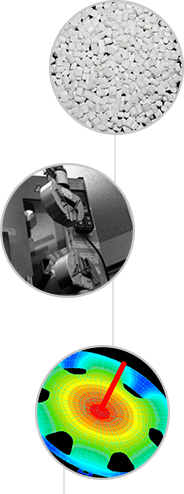
Plastics exhibit a wide range of material behavior that is non-linear in nature. Within the application range of most commercial products, the properties with vary with temperature, time, orientation and environmental conditioning such as humidity and chemical exposure. Tests are available to capture the viscosity, thermal properties and mechanical properties of these materials. Mechanical properties include tensile, compressive and shear stress-strain data over wide range or temperatures and strain rates (speeds), as well as orientations, visco-elastic properties in melt and solid states. Fatigue, creep and creep rupture experiments along with visco-elastic tests provide insights into the long term behavior of these materials. Thermal properties include conductivity, specific heat, crystallization and cure kinetics data.

TestPaks typically ordered for Plastic

TestPaks for this Material Type
Testpak ID Name
G-771 LS-DYNA High Speed Tensile Rate Dependent Model (MAT_019 or MAT_024 or MAT_089)
G-730 Abaqus Creep Model (*CREEP, LAW=TIME)
G-711 Abaqus Elastic and Plastic model (*ELASTIC *PLASTIC)
G-003 Moldflow Post-Filling + Juncture Losses
U-061 Universal TestPak-Injection Molding of Anisotropic Materials
G-712 Abaqus Rate Dependent Viscoplastic (*RATE DEPENDENT)
G-460 Universal TestPak-Rate Dependent Model
G-007 Moldflow Uncorrected Anisotropic Shrinkage
U-063 Moldflow CRIMS Shrinkage Option
Q-305 WSS-M99D68-A1

Tests typically ordered for Plastic

Tests for this Material Type
Test ID Name
M-204 Tensile Stress-Strain, Strength, and Modulus
R-011 Capillary Rheology (1 Temperature)
M-410 Dynatup Instrumented Impact
M-232 High Speed Tensile Stress-Strain
M-250 Tensile Creep
M-206 Tensile Stress-Strain, Strength, Modulus and Poisson's Ratio
M-221 3 Point Flexural Stress-Strain, Strength and Modulus
M-425 Izod Pendulum Impact
M-030 Tensile Strength
T-020 Heat Deflection Temperature

Get Started

1
Share your requirements

Tell us about the material, application, environment, and any method, standard, specimen, or conditioning constraints.

2
Confirm the approach

We’ll align the appropriate method, specimen requirements, and deliverables to your objectives, then provide a quote and test plan.

3
Submit your PO and materials

Send the purchase order and arrange delivery of materials or specimens so the program can move into scheduling and execution.

4
Receive your results

You’ll receive an engineering test report with digital data delivery, along with any agreed raw data or method-appropriate outputs.

Typical turnaround for most testing is five business days. Longer-duration programs may require more time.

Testing for Plastic
livechat button