Testing for composite
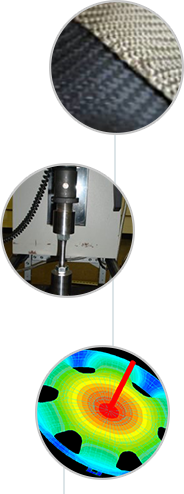
Structured composites are made up of layers of polymer resin-impregnated fabric (prepreg) fused together in different orientations to create a sheet with desired properties. As many as 6 to 20 layers may be used in a typical composite with repetitions of orientations in 0º, 90º and 45º, though other orientation angles may also be used [1]. The end result may be to tune the resulting sheet to have certain desired directional properties for a particular application. Multiscale material models are being increasingly applied for high-level simulation of complex materials, such as continuous reinforced material products (unidirectional and woven product forms). These multiscale material models require input data from a minimum of experimental tests, which are then used to characterize a multiscale material model that can be used in structural simulations within a variety of commercial finite element solvers. Using these models, it is possible is to predict the performance of layups from single layer properties, as well as performance of these composites under complex loadings.
TestPaks typically ordered for composite
| Testpak ID | Name |
|---|---|
| G-794 | LS-DYNA Laminated Composite Fabric (MAT_058) |
| G-706 | Abaqus Orthotropic Composite |
| G-173 | DIGIMAT MX Elasto-plastic with Damage (EP+D) |
| G-267 | SIGMASOFT Thermoset: Standard Filling + Curing + Warpage |
Tests typically ordered for composite
Get Started
-
Share your requirements
Tell us about the material, application, environment, and any method, standard, specimen, or conditioning constraints.
-
Confirm the approach
We’ll align the appropriate method, specimen requirements, and deliverables to your objectives, then provide a quote and test plan.
-
Submit your PO and materials
Send the purchase order and arrange delivery of materials or specimens so the program can move into scheduling and execution.
-
Receive your results
You’ll receive an engineering test report with digital data delivery, along with any agreed raw data or method-appropriate outputs.