Testing for Metal
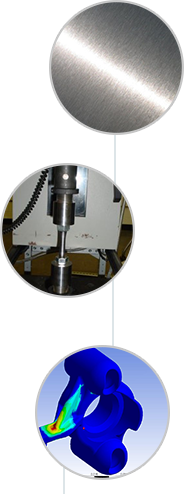
Metals are generally well characterized in commercially available databases except where large deformation occurs and in the support of crash applications where rate dependent properties are needed. Data for sheet metal forming and large deformation plasticity extending to failure is needed for a number of design/simulation applications. Properties are known to vary greatly with method of processing and treatments and careful attention must be paid to ensure that the material being tested has been processed in the same manner as the product being designed. An area of new interest applies to additively manufactured metallic components.
TestPaks typically ordered for Metal
| Testpak ID | Name |
|---|---|
| G-771 | LS-DYNA High Speed Tensile Rate Dependent Model (MAT_019 or MAT_024 or MAT_089) |
| G-711 | Abaqus Elastic and Plastic model (*ELASTIC *PLASTIC) |
| G-753 | Ansys Isotropic Hardening (BISO, MISO) |
| G-712 | Abaqus Rate Dependent Viscoplastic (*RATE DEPENDENT) |
| G-601 | Altair RADIOSS Johnson-Cook Quasi-Static Material Model (Law 2) |
| G-790 | LS-DYNA Forming (Barlat 3-parameter model: MAT_036) |
| G-776I | LS-DYNA (MAT_024 or SAMP)+GISSMO shell element failure model for metals |
| G-776 | LS-DYNA GISSMO Failure Model |
| G-791 | LS-DYNA Transversely Anisotropic Elastic Plastic (MAT_037) |
| G-460 | Universal TestPak-Rate Dependent Model |
Tests typically ordered for Metal
Get Started
-
Share your requirements
Tell us about the material, application, environment, and any method, standard, specimen, or conditioning constraints.
-
Confirm the approach
We’ll align the appropriate method, specimen requirements, and deliverables to your objectives, then provide a quote and test plan.
-
Submit your PO and materials
Send the purchase order and arrange delivery of materials or specimens so the program can move into scheduling and execution.
-
Receive your results
You’ll receive an engineering test report with digital data delivery, along with any agreed raw data or method-appropriate outputs.